
South Korea’s disgraced former President Park Geun-hye was arrested
and jailed Friday over high-profile corruption allegations that have
already ended her tumultuous four-year rule and prompted an election to
find a successor.
A convoy of vehicles,
including a black sedan carrying Park, entered a detention facility near
Seoul before dawn after the Seoul Central District Court granted a
prosecutors’ request to arrest her.
Many
Park supporters waved national flags and shouted “president” as Park’s
car entered the facility. An opponent held up a mock congratulatory
ribbon with flowers that read “Park Geun-hye, congratulations for
entering prison. Come out as a human being after 30 years.” Prosecutors
can detain her for up to 20 days before formally charging her.
The
Seoul court’s decision is yet another humiliating fall for Park, South
Korea’s first female president who was elected in 2012 amid overwhelming
support from conservatives, who recall her dictator father as a hero
who lifted the country from poverty in the 1960-70s despite a record of
severe human rights abuses.
Extorting big businesses
Prosecutors
accuse Park of colluding with a confidante to extort big businesses,
take a bribe from one of the companies and commit other wrongdoing. The
allegations led millions of South Koreans to protest in the streets
every weekend for months before lawmakers impeached her in December and
the Constitutional Court ruled in March to formally remove her from
office.
It made Park the country’s first
democratically elected leader to be forced from office since democracy
came here in the late 1980s. South Korea will hold an election in May to
choose Park’s successor. Opinion surveys say liberal opposition leader
Moon Jae-in, who lost the 2012 election to Park, is the favorite.
Prosecutors
can charge Park without arresting her. But they said they wanted to
arrest her because the allegations against her are “grave” and because
other suspects involved the scandal, including her confidante Choi
Soon-sil and Samsung heir Lee Jae-yong, have already been arrested.
The
Seoul court said it decided to approve Park’s arrest because it
believes key allegations against her were confirmed and there were
worries that she may try to destroy evidence. Park’s conservative party
described her arrest as “pitiful,” while the liberal politician favored
in polls to succeed her said the country took a step toward restoring
“justice and common sense.”
The camp of
Moon Jae-in, who lost the 2012 presidential race to Park, said in a
statement that the nation should now “turn the page on painful history”
and focus on creating a fair and clean country.
A
day earlier, Park was questioned at a court hearing for nearly nine
hours. As she left for the hearing, hundreds of her supporters, many of
them elderly citizens, gathered at her private Seoul home. They wept,
chanted slogans and tried to block Park’s car before being pushed back
by police.
In the coming weeks, prosecutors
are expected to formally charge Park with extortion, bribery and abuse
of power. Her bribery conviction alone is punishable by the minimum 10
years in prison and the maximum life imprisonment in South Korea.
Prosecutors
believe Park conspired with Choi and a top presidential adviser to
bully 16 business groups, including Samsung, to donate 77.4 billion won
($69 million) for the launch of two nonprofits that Choi controlled.
Company executives said they felt forced to donate in fear of
retaliatory measures including state tax investigations.
Park
and Choi are accused of separately receiving a bribe from Samsung and
colluding with top officials to blacklist artists critical of Park’s
policies to deny them state financial assistance programs, according to
prosecutors. Park also is alleged to have passed on state secrets to
Choi via a presidential aide.
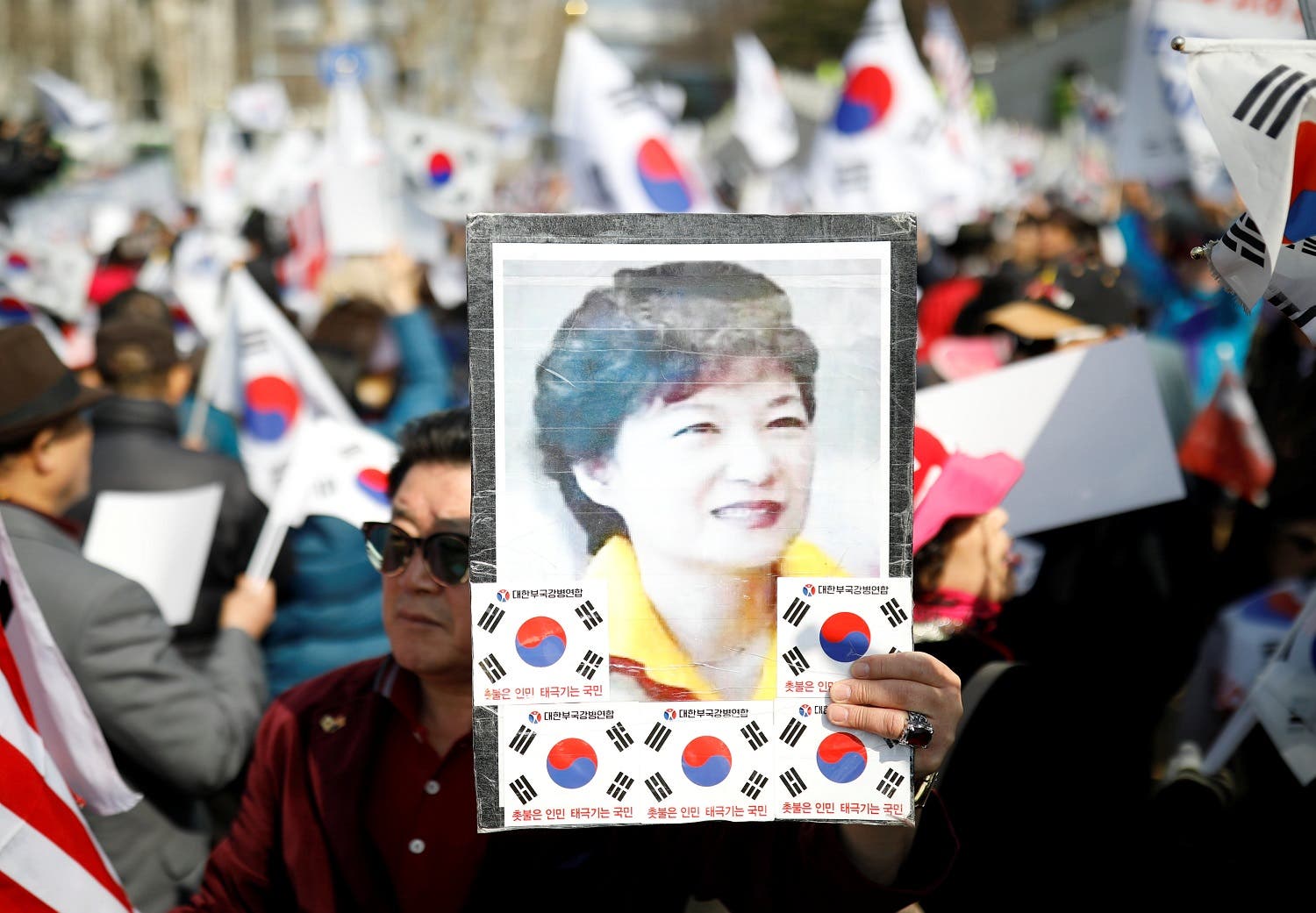 A supporter of Park Geun-hye holds up her portrait during a rally
in front of a prosecutor’s office in Seoul on March 21, 2017. (Reuters)
A supporter of Park Geun-hye holds up her portrait during a rally
in front of a prosecutor’s office in Seoul on March 21, 2017. (Reuters)Denying allegations
Park and Choi
deny most of the allegations. Park has said she only let Choi edit some
of her presidential speeches and got her help on “public relations”
issues. Choi made similar statements. The women, both in their 60s, have
been friends for 40 years. Park once described Choi as someone who
helped her when she had “difficulties,” an apparent reference to her
parents’ assassinations in the 1970s.
Park’s
father, Chung-hee, was gunned down by his own intelligence chief in
1979, five years after his wife was killed in an assassination attempt
that targeted him. Park Geun-hye served as first lady after her mother’s
death.
After her father’s killing, Park
Geun-hye left the presidential Blue House and secluded herself from the
public eye before she entered politics in the late 1990s - when public
nostalgia for her father emerged after the country’s economy was hit
hard by the Asian financial crisis. She had since become an icon of
South Korean conservatives, earning the nickname “Queen of Elections”
for her ability to led her conservative party to win tight elections.
Park
now becomes South Korea’s third head of state to be jailed after
leaving office. Former presidents Chun Doo-hwan and Roh Tae-woo, both
previously army generals, received a life sentence and a 17-year prison
term, respectively, in 1996 on charges including treason and bribery.
They were released in December 1997 on a special presidential amnesty.
Chun
and Roh staged a 1979 coup that put Chun in power more than eight years
after Park Chung-hee’s death. Roh was elected president in 1987 after
Chun’s government caved to massive pro-democracy protests and accepted
direct, free elections.
In 2009,
prosecutors questioned former liberal President Roh Moo-hyun over
corruption allegations, but they later closed the investigation after
Roh leaped to his death.


No comments:
Post a Comment